Foundations of Intelligence
Establishes the conceptual foundations of intelligence and explains why current AI debates are confused by the failure to distinguish data, information, knowledge, experience, and wisdom.
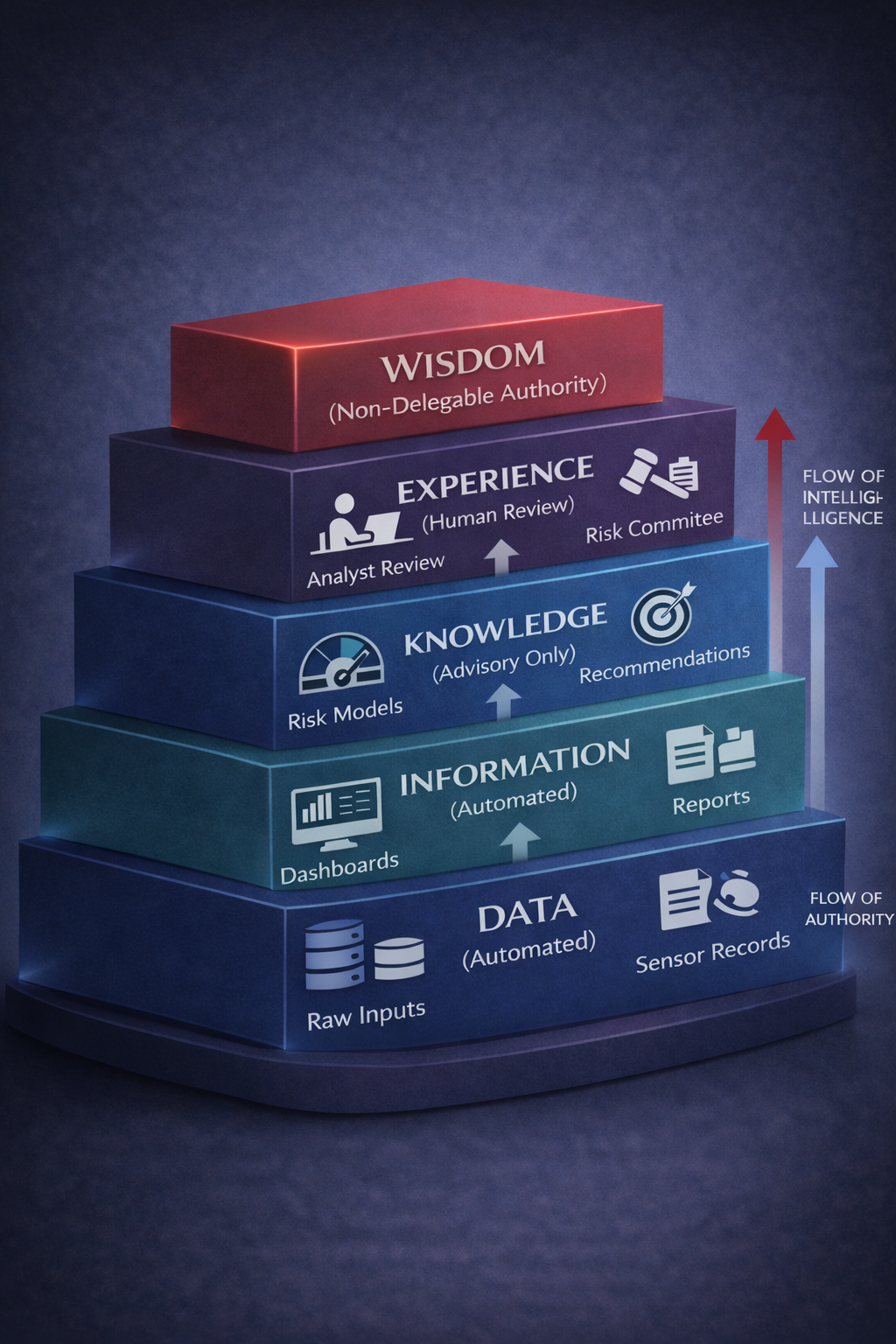
The definitive, single-volume edition. Combines all three books of the WEKID trilogy into one continuous work and adds substantial new content that turns the framework from concept into operational system.
The recommended starting point for executives, architects, governance leaders, and policy professionals who want both the conceptual foundation and the operational mechanics in one place.
three books, one continuous argument
All three books unified into a single continuous work, preserving the original arc from conceptual foundations through governance design to operational application.
Establishes the conceptual foundations of intelligence and explains why current AI debates are confused by the failure to distinguish data, information, knowledge, experience, and wisdom.
Examines how intelligence must be governed once those layers are understood, introducing principles for authority, accountability, and responsible oversight in AI systems.
Demonstrates how the framework can be implemented in real-world environments — enterprise architecture, procurement, assurance and audit, and public-sector oversight.
exclusive to this edition
The definitive edition adds three substantial pieces of original material — available only in this volume — that move WEKID from analytical lens to repeatable, auditable, enforceable governance discipline.
A scoring scale, weighted aggregation formula, and hard gates that convert WEKID from an analytical lens into a repeatable, auditable evaluation framework for AI outputs.
A reference architecture for governed intelligence, including the deterministic treatment of each layer — what distinguishes WEKID from conventional AI evaluation.
Twelve documented patterns of AI failure — fabricated legal citations, biased credit decisions, runaway autonomous agents, invisible executive risk — each mapped to the specific epistemic layer where it originates and the gate that would have prevented it.
who this edition is for
Leaders accountable for AI-driven outcomes who need both the conceptual frame and the operational mechanics.
System designers building governed-intelligence reference architectures across enterprise and platform environments.
Professionals responsible for authority allocation, oversight, audit, and assurance in AI-influenced decision systems.
Public-sector and institutional leaders designing AI policy, regulatory frameworks, and procurement controls.
Advisors who frame AI conversations for boards, governments, and executive teams using a coherent epistemic model.
Directors and investors evaluating organizations whose AI systems shape outcomes — and the liability that follows.
The single-volume edition gives you the complete trilogy plus the scoring framework, implementation architecture, and twelve real-world failure mitigations — the recommended starting point for anyone serious about governing intelligence in the AI era.