Published & Pledged
The five-layer Epistemic Maturity Model, the Decision Authority Model, and the conformance criteria are openly published and pledged to stay that way. Anyone may read, teach, and build on the framework.
An open standard for AI decision authority
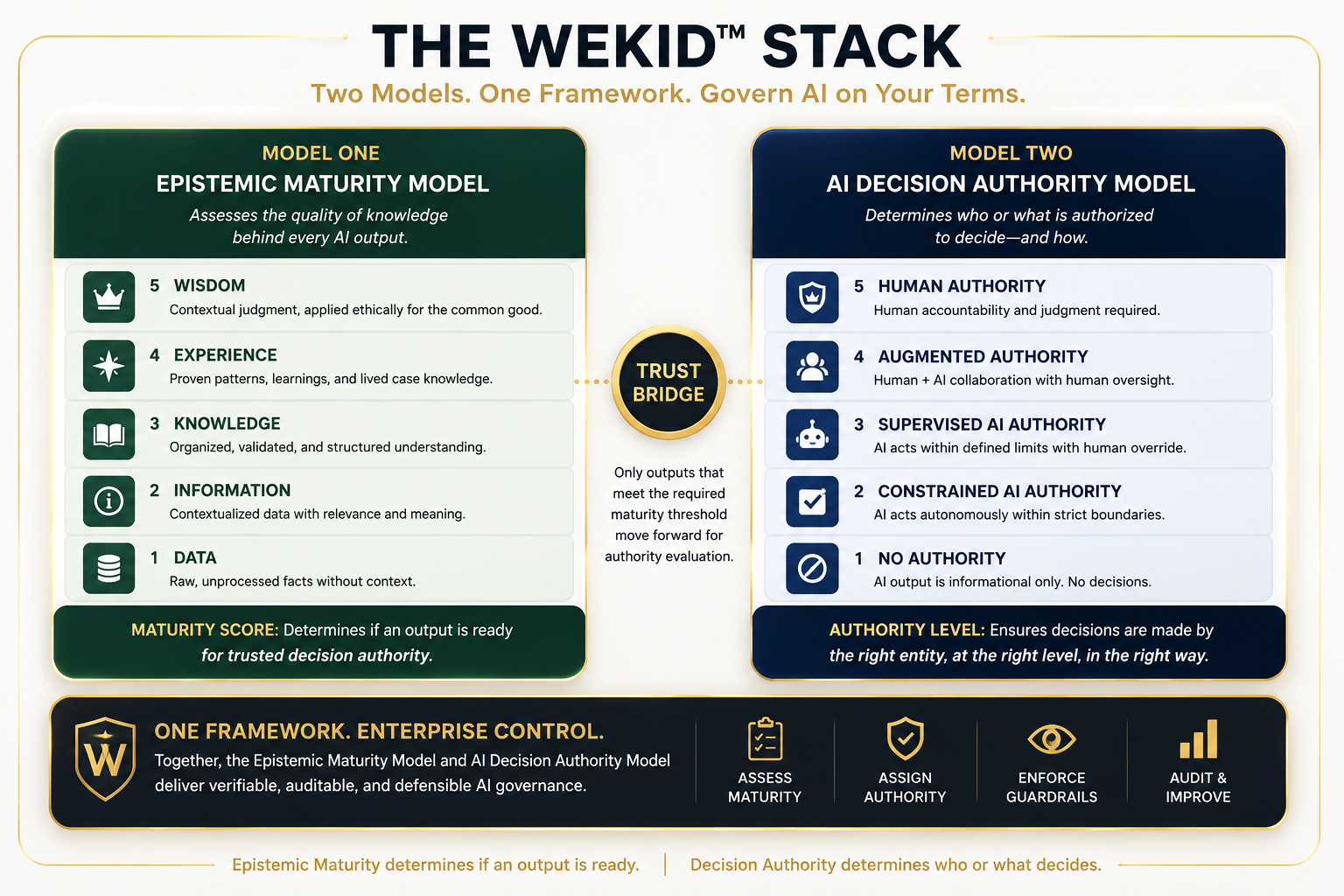
WEKID (pronounced “Wicked”) is an emerging framework, standard, and ecosystem built around two complementary models: the Epistemic Maturity Model, which evaluates the quality and maturity of AI-generated knowledge, and the AI Decision Authority Model, which governs how much authority may be delegated.
Both models are openly published, and the WEKID Pledge commits them to stay that way—regardless of WEKID’s market position. WEKID LLC stewards the standard, licenses it commercially, and certifies the practitioners who apply it. A growing community of researchers, auditors, and domain experts contributes evidence, domain profiles, and proposed changes through a governed RFC process.
What WEKID is
WEKID draws upon principles from epistemology, decision authority, social engineering, zero trust, and organizational governance. The Epistemic Maturity Model evaluates what an intelligent system knows and how well that knowledge can be trusted. The AI Decision Authority Model governs what the system may be trusted to decide or do.
The five-layer Epistemic Maturity Model, the Decision Authority Model, and the conformance criteria are openly published and pledged to stay that way. Anyone may read, teach, and build on the framework.
WEKID defines and stewards two complementary models: the Epistemic Maturity Model for evaluating AI-generated knowledge and the AI Decision Authority Model for governing delegated authority.
Enterprises, agencies, schools, software vendors, and service providers license WEKID for the use case that fits their role.
Practitioner and Authority credentials create a common language for people applying WEKID in products, programs, and operating models.
The WEKID ecosystem at a glance
What WEKID solves
Most discussions about AI begin with capability. WEKID begins by separating two questions: How mature is the knowledge, and how much authority should follow? Intelligent systems should not inherit authority simply because they demonstrate capability.
The Epistemic Maturity Model evaluates the quality, reliability, and applicability of AI-generated knowledge. The AI Decision Authority Model then determines whether that system should inform, influence, recommend, or act—before authority is delegated, not after failures occur.
best fit
evidence
Many AI failures begin as breakdowns in knowledge maturity and become consequential when apparent expertise silently turns into delegated authority. Publicly reported incidents—from hallucinated citations and benefits errors to runaway agents—show why organizations must evaluate knowledge and govern authority as separate but connected responsibilities.
Adoption pathways
Read and apply the framework at no cost, contribute to it, or license it commercially. Organizations adopt WEKID to strengthen their own AI governance; authorized partners build products, services, and training that extend the ecosystem; and the community contributes the evidence and domain profiles both models are calibrated against.
Free, and no partner agreement required. Read the published framework, apply it in your own organization, contribute failure evidence or research, join a domain working group, or propose a change through the RFC process.
The offering WEKID sells directly today. Practitioner and Authority credentials across technical and non-technical tracks—and the foundation for partner and enterprise authorization.
License WEKID to bring governance products, training, or solutions to market. Training & Certification Partners, Product Providers, and Solution Providers—each with the license that fits.
License WEKID to build governed AI capabilities that assess Epistemic Maturity and apply AI Decision Authority controls across public-sector, commercial, and educational environments.
The WEKID Pledge
“WEKID will always carry the open torch — even if the standard evolves past it.”
When one company owns a standard, openness is a strategy—and strategies get revised. So the pledge is backed by structure, stated in advance:
“Artificial Intelligence will continue to reshape the world. The greater question is whether it has earned the authority to reshape our decisions.”