Own Your Authority Model
Build runtime scoring, gating, ceiling resolution, and escalation directly into your own systems and operating model.
Enterprise Program
Implement the WEKID Framework to evaluate knowledge maturity, govern AI Decision Authority, and deploy intelligent systems with confidence. Whether you're building internal capabilities, integrating commercial AI, or enabling agentic systems, WEKID provides the governance model that aligns what AI knows with what it should be trusted to decide.
Your terms follow your organization type. Planning to sell WEKID-based offerings to others instead? That's the partner route.
why build with WEKID
An internal-use license gives your organization the WEKID framework and IP to evaluate epistemic maturity, carry it across the Trust Bridge to a maturity ceiling, and govern Decision Authority — both models and the bridge between them, in your own systems, without depending on a single vendor.
Build runtime scoring, gating, ceiling resolution, and escalation directly into your own systems and operating model.
Apply the Epistemic Maturity Model — Data, Information, Knowledge, Experience, Wisdom — before autonomy expands too far, too fast.
Certify your people, then build and run WEKID-based capabilities with your own teams.
how WEKID fits your stack
The gateways, guardrails, and governance platforms you already run enforce how AI behaves at runtime. WEKID is the epistemic layer beneath them — it defines what to enforce, on whose authority, and how mature the knowledge must be. Complementary, not competing.
WEKID doesn’t replace the tools you already run. It tells them what to enforce, and on whose authority.
what you build
An internal-use license gives your teams a foundation for governed, defensible AI authority. These are the outcomes enterprises build on it.
Outputs that are scored, constrained, escalated, or approved with policy-backed evidence.
Clear boundaries for what AI can recommend, decide, trigger, or escalate — capped by the evidence, floored by the consequence, and never set by the confidence.
Evidence, rationale, and traceability that support internal and external accountability — including which of the two determinants bound each outcome.
A path from experimentation to structured, defensible intelligent-system outcomes.
Every release carries a maturity ceiling from measured evidence and resolves to an Authority Level against the stakes floor, with your control library verified in the artifact.
what WEKID catches
Publicly documented AI incidents fall into a small set of recurring failure types — each one a breakdown at a specific WEKID layer. These are analyzed incidents, not WEKID deployments; each card shows where a gate would have intervened.
Automated eligibility systems terminated public benefits on flawed assumptions — triggering legal challenges and mass reversals.
With WEKID: verification steps and exception handling would have run before any action took effect.
After an incident, the organization could say only that the AI failed — not why. No epistemic audit trail meant failed audits and forced shutdowns.
With WEKID: a layer-by-layer audit trail would have reconstructed the root cause.
Executives learned of declining AI quality only after public disclosure, with no prior risk signal.
With WEKID: board-level governance reporting would have surfaced the decline early.
adoption architecture
A visual model for how organizations move from WEKID adoption to certified capability, implementation, accountability, and scale.
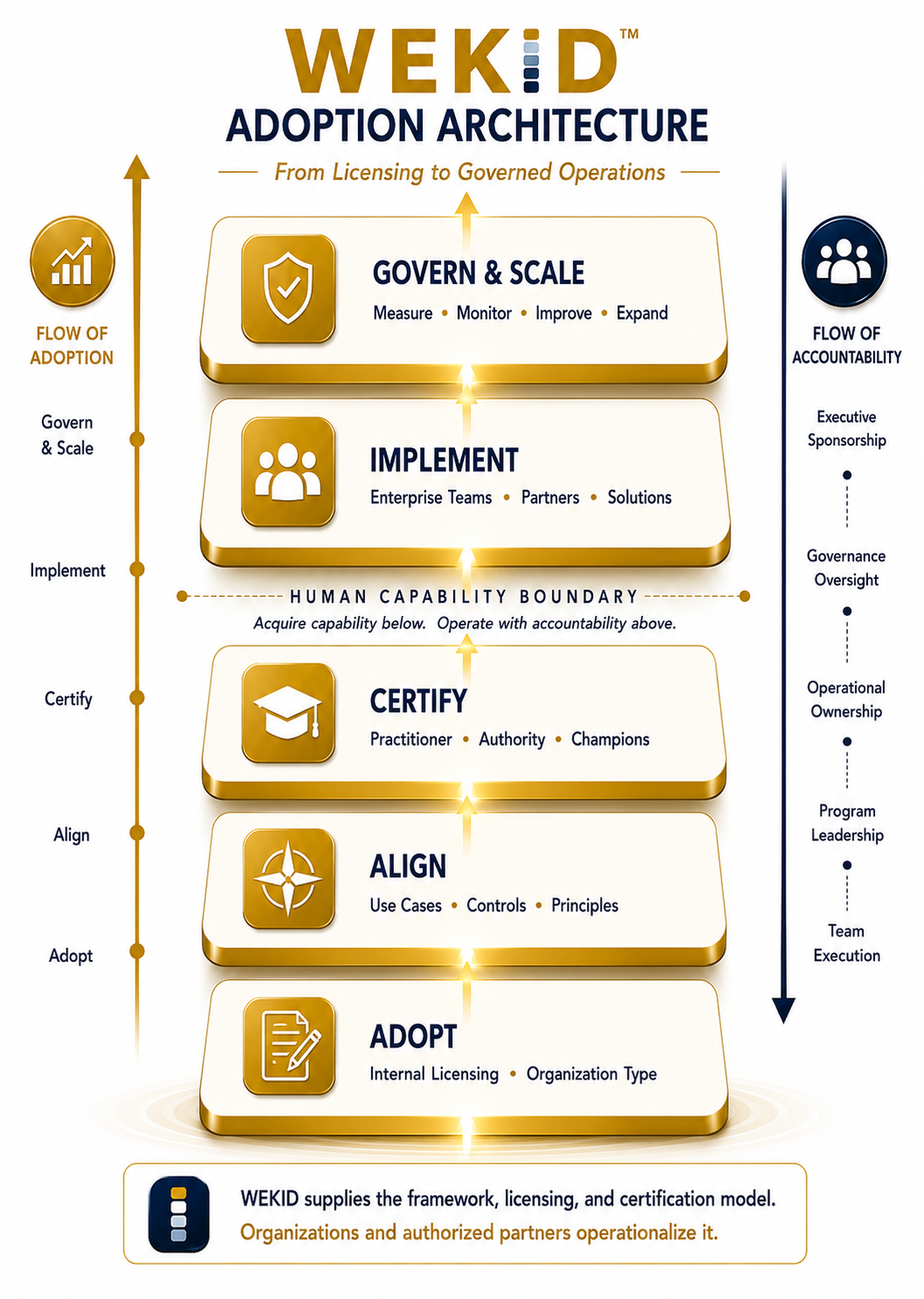
WEKID supplies the framework, licensing, and certification model. Organizations and authorized partners operationalize it.
see it operate
The architecture above is the model. This is the operating reality of the Govern & Scale stage: WEKID scores a proposed agent action, resolves an Authority Level, and routes it as a workflow your platforms execute and your people approve.
governance → platform orchestration
Each scenario runs end to end — WEKID’s gate, the platform actions it triggers, the human review it escalates to, and the outcome it records. Every workflow exports as a spec your team can map or import into the systems you already run.
governed delivery
Anyone in your organization can now build an application by describing it. That capability is not going back in the bottle, and restricting individual tools only moves it to the next one. The durable response is not to control who builds — it is to govern the path from build to production, and to have that path arrive with the application rather than waiting to be adopted.
Shadow IT was about unapproved purchases. AI-assisted application sprawl is software appearing faster than any process can discover, review, and control it — built by people who were not avoiding governance so much as trying to get something done by Thursday.
The uncomfortable part: the people who most need governance are the least likely to adopt it. Governance that must be chosen reaches the teams that were already disciplined.
The obvious move is to insert your standards into the build prompt. That mechanism is right — but the prompt is how a control gets generated. The control is what exists afterwards and can be checked: the code, the configuration, the test, the gate, the recorded approval.
The standard this sets: an application that was told to encrypt in transit and did not must look, to whatever grades it, exactly like one that was never told.
Each release is assessed against the five WEKID layers from what was actually built — requirement traceability, specification density, tests and coverage, release history, recorded human approval — and resolves to a maturity ceiling, then to an Authority Level once the stakes floor is applied.
Every result carries its basis: scanned, tested, attested, or merely declared. A control satisfied only by declared carries no weight, however many there are.
the enterprise control library
Your organization keeps a control library — its own standing requirements, in packs selected by what an application actually is: holds personal data, faces the internet, moves money, acts on its own. The pipeline verifies each one against the built artifact and records how strongly it established it.
why not one central control plane
A central control plane has to sit in the path of every build to enforce anything — so it has to know about every build. The builds it does not know about are precisely the population it was bought for. It governs what already agreed to be governed.
In a federation, every team keeps its own pipeline, every pipeline reports the same evidence in the same shape, and everything resolves on the same Authority scale. Consolidate what builds the applications, not the applications themselves.
fleet visibility
Which of our applications handle money and have never had a review? The usual way to answer that is to instrument the applications — agents in production, a registry, network chokepoints — all of which need the applications to cooperate.
see it operating
A complete delivery platform — version control, pipeline, scanners, environments — that resolves an Authority Level for every release from measured evidence. Watch the same artifact score 76 out of 100 and ship, then score 76 out of 100 and be refused. It also carries its own course: both models and the Trust Bridge between them in plain English, and a page for each Authority Level — AL-0 through AL-4 — covering what it permits and what it forbids.
It is not attached to any one build tool. A governance vessel needs three properties: it runs on the artifact rather than the intent, it produces evidence the builder did not author, and it sits outside the builder’s reach. A CI pipeline is one implementation — an internal developer platform, a merge-queue policy engine, or an agent harness with an external evaluator are others.
organization types
Each type maps to an internal-use license variant. The license is a function of your organization type—not a separate product.
Agencies, defense, intelligence, and regulated public bodies building governed and high-assurance AI for mission and public-service use.
Your license: Internal-use, government terms—procurement-compatible, with data sovereignty and high-assurance options.
Companies adopting WEKID to govern copilots, agents, and decision systems across their own business operations.
Your license: Internal-use, commercial terms—standard grant for building and running WEKID capabilities in-house.
Universities, research institutions, and programs using WEKID for teaching, curriculum, and applied research.
Your license: Internal-use, educational terms—academic and non-commercial scope. (Reselling training is the partner route.)
begin your WEKID adoption journey
Each step gives your team a practical next action: request licensing, align your use case to the framework, and begin the internal-use licensing discussion.
Tell us your organization type, intended internal use, and the capabilities you plan to build.
Map your initiatives to WEKID reference capabilities with build paths, and prepare the people who will design, review, and govern intelligent systems.
Execute the agreement appropriate for your sector and begin building governed capabilities within your organization.
build the business case
Before you license, model the value. The WEKID ROI Calculator estimates risk reduction, delivery acceleration, productivity, and compliance efficiency for a governed AI operating model—then produces a client-ready, board-ready summary you can export.
what it models
internal use vs. resell
license & terms